
October 07, 2026 · par Salsal Marketing
VQ35DE vs VQ35HR vs VQ37VHR: Nissan VQ Engine Guide
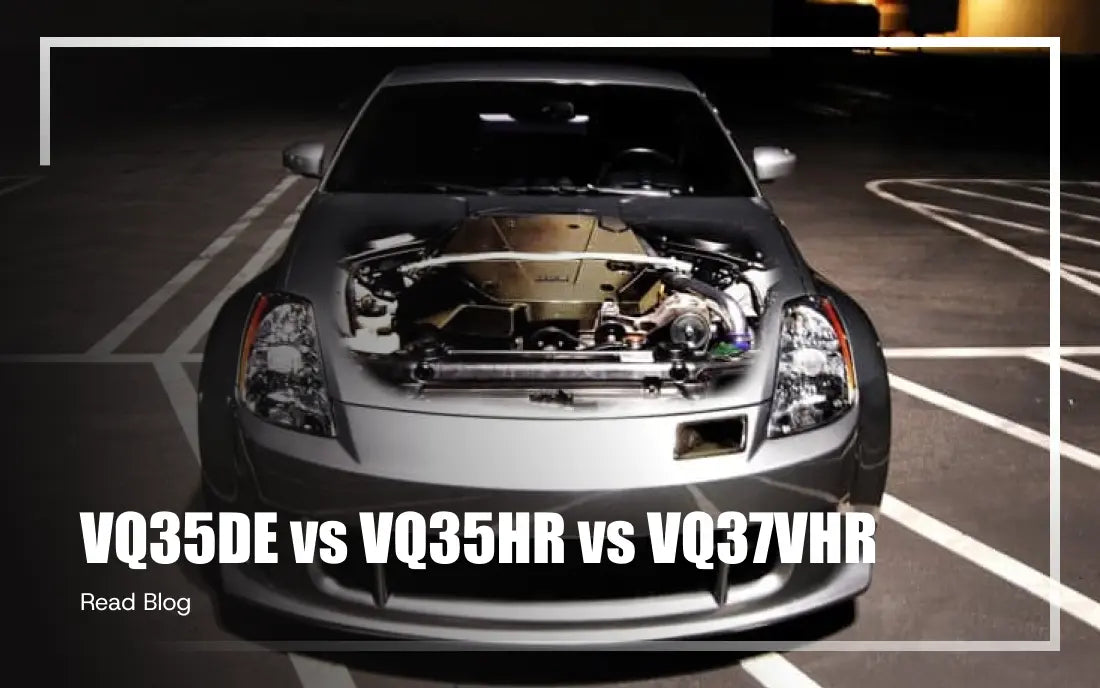
The Nissan VQ is a 3.5L or 3.7L V6 that powered almost every rear-wheel-drive Nissan and Infiniti from the late 1990s through the 2010s. Three versions matter most: the VQ35DE, the revised VQ35HR, and the larger VQ37VHR. Each has different output, different hardware, and fits different cars. Here is everything you need to know.
Looking for a VQ engine? See compression-tested Nissan VQ engines in stock.
What Is the Nissan VQ Engine? A Short History of the Family
The Nissan VQ family launched in 1994. Ward’s Auto named it one of the Ten Best Engines every year from 1995 to 2007, a run that is basically unmatched in the industry. The engine started as a smooth V6 for sedans and family crossovers, then found its way into the 350Z and G35, turning it into a serious performance platform. Nissan kept updating the VQ through three main versions before moving toward the turbocharged VR30DDTT in newer Infiniti models. That long production run is why used JDM units are still widely available and well-supported with aftermarket parts.
VQ Engine Specs at a Glance
|
Code |
Displacement |
Valvetrain |
Output |
Years Built |
|
VQ35DE |
3.5L |
DOHC 24v VVT |
222 to 287 hp |
2000 to 2013 |
|
VQ35HR |
3.5L |
DOHC 24v CVTCS |
300 to 306 hp |
2006 to 2012 |
|
VQ37VHR |
3.7L |
DOHC 24v VVEL |
328 to 332 hp |
2007 to 2020 |
All three are 60-degree V6 engines with port injection and a timing chain. No direct injection, which keeps intake valves cleaner over time.
VQ35DE: The Original 3.5L
The VQ35DE is the most common version. It went into the 350Z, G35, Maxima, Murano, Altima V6 and Quest. Output ranged from 222 hp in the Murano to 287 hp in the later 350Z. It runs DOHC with 24 valves and Nissan’s first-generation variable valve timing.
Which cars use the VQ35DE:
-
Nissan 350Z, 2003 to 2006
-
Infiniti G35 coupe and sedan, 2003 to 2007
-
Nissan Altima V6, 2002 to 2006
-
Nissan Maxima, 2002 to 2008
-
Nissan Murano first generation, 2003 to 2007
-
Nissan Quest V6, 2004 to 2009
-
Infiniti FX35, 2003 to 2008
Browse VQ35DE engines for sale in stock.
Non-Rev Up vs Rev Up VQ35DE
The 2003 to 2005 350Z used the Non-Rev Up version. From 2006, Nissan updated the cams, porting and intake, calling it the Rev Up. Output climbed from 287 hp to 306 hp in the 350Z. The two versions are not fully interchangeable. Cam profiles and intake manifolds differ, so match like for like when replacing.
VQ35HR: What Changed, and Which Cars Got It
The VQ35HR came out in 2006. HR stands for High Revolution. Key changes over the VQ35DE include revised CVTCS on both intake and exhaust cams, a higher rev limit around 7,500 rpm, improved intake ports and a revised combustion chamber. Output is 300 to 306 hp. It fits the 2006 to 2008 350Z and the 2006 to 2007 Infiniti G35. It will not drop straight into an earlier 350Z without modification.
Browse VQ35HR engines for sale.
VQ37VHR: The 3.7L with VVEL, in the 370Z, G37 and Q50
The VQ37VHR is the top of the VQ family. The 3.7L displacement and VVEL system are the two big differences. VVEL continuously varies both valve lift and timing across the full rpm range, replacing traditional throttle control and making the engine more responsive. Output is 328 to 332 hp. It revs cleanly to around 7,500 rpm.
Which cars use the VQ37VHR:
-
Nissan 370Z, 2009 to 2021
-
Infiniti G37 coupe, sedan and convertible, 2008 to 2013
-
Infiniti Q50 3.7, 2014 to 2015
-
Infiniti Q60 3.7, 2014 to 2015
-
Infiniti FX37, 2009 to 2013
Browse VQ37VHR engines for sale.
VQ35DE vs VQ35HR vs VQ37VHR: Which One Fits Your Car or Swap?
Here is the short version:
-
350Z or G35 (2003 to 2005): VQ35DE. Match Non-Rev Up to Non-Rev Up.
-
350Z or G35 (2006 to 2007): VQ35HR fits. Late VQ35DE also works with some adaptation.
-
370Z or G37: VQ37VHR. VVEL wiring and ECU requirements make cross-swapping complex.
-
Maxima, Murano or Altima V6: Stick with the VQ35DE. The HR and VHR variants have different accessory layouts.
For engine and transmission combos, Nissan transmissions in stock can be matched to most VQ applications.
Common VQ Engine Problems
The VQ family is reliable, but a few issues come up at higher mileage.
Oil consumption on Rev Up engines: The Rev Up VQ35DE has a known oil consumption issue on some units due to piston ring sealing. Check compression and leakdown figures before buying.
Oil gallery gasket failure on the VQ35HR and VQ37VHR: The upper oil gallery gaskets can fail and allow coolant and oil to mix. A compression test alone will not catch this, so ask specifically about it.
Timing chain noise: All three versions use a timing chain. At high mileage, chain stretch or tensioner wear causes a cold-start rattle. Persistent noise means the chain needs attention.
Rear main seal leaks: Seal weeping above 120,000 miles is common on the VQ35DE. It is not catastrophic, but watch for oil residue at the back of the block.
Other VQ Engines You Will See: VQ30DE, VQ40DE, and the VR30DDTT
VQ30DE (3.0L): Older Maxima and J30 Infiniti engine from the 1990s. Not related to 350Z or G35 fitment.
VQ40DE (4.0L): Goes into the Frontier, Pathfinder and Xterra. Truck-oriented, completely different application.
VR30DDTT (3.0L twin-turbo): Replaced the VQ in the Q50 Red Sport and Q60 Red Sport. Turbocharged, direct injected, different mounts and ECU. Not a VQ swap target.
How to Read a VQ Engine Code and Confirm Fitment by VIN
The stamped code tells you the series, displacement and valve system. VQ35DE breaks down as: V = VQ family, Q = family identifier, 35 = displacement class, D = valve timing generation, E = tune level. For a full breakdown of how Nissan engine codes work, see our JDM Engine Codes Explained guide.
Confirming fitment by VIN is the safest step before purchasing. Accessory drive layouts, oil cooler fittings and transmission bolt patterns can vary between model years and markets.
What to Check Before Buying a Used JDM VQ Engine
-
Compression test results: 175 to 195 psi per cylinder with balanced readings
-
Oil gallery gasket condition on VQ35HR and VQ37VHR units
-
Oil consumption history on Rev Up VQ35DE engines
-
Drive type and accessory layout match to your vehicle
-
Compression test report reviewed in detail: see How to Read a Compression Test Report
-
Mileage documentation from the Japanese exporter
Not sure it fits? Send us your VIN and we will confirm fitment before you buy. Call 253-536-6855.
Shop VQ35DE, VQ35HR and VQ37VHR Engines
JDM Seattle stocks compression-tested VQ series engines imported from Japan. Every unit ships with a compression test report. We ship nationwide by freight. We sell and ship engines but do not offer installation services.
Browse Nissan VQ engines in stock
FAQ
Is the VQ35DE a good engine?
Yes. It ran on Ward’s Ten Best Engines list for 13 years straight. It is durable, well-supported with parts and responds well to regular maintenance.
Which VQ engine is best?
Depends on your goal. The VQ37VHR makes the most power and is the most refined. The VQ35DE is the most common and easiest to source parts for. The VQ35HR sits in between.
What is better, VQ35DE or VQ35HR?
The VQ35HR makes more power and revs higher. The VQ35DE is simpler and easier to source. For a straight swap without wiring changes, the VQ35DE is often the easier choice.
Can you put a VQ35HR or VQ37VHR in a 350Z or G35?
A VQ35HR swap into a 2003 to 2005 350Z is done regularly but requires matching intake manifolds and cam sensors. A VQ37VHR swap is more complex due to VVEL wiring.
How many miles does a VQ35DE last?
With regular oil changes, most VQ35DE engines reach 150,000 to 200,000 miles or more.
Does a JDM VQ35DE work with a US-market harness and ECU?
In most cases, yes. JDM and USDM 350Z and G35 engines use compatible connectors. Confirm with your VIN before ordering.